Research
Our research focuses on understanding how the human auditory system processes
complex sounds in real-world conditions and how we can diagnose hearing loss
that affects these processes. We combine electrophysiology, psychophysics,
and computational approaches.
See a list of our publications here.
Fast hearing diagnosis with the parallel ABR
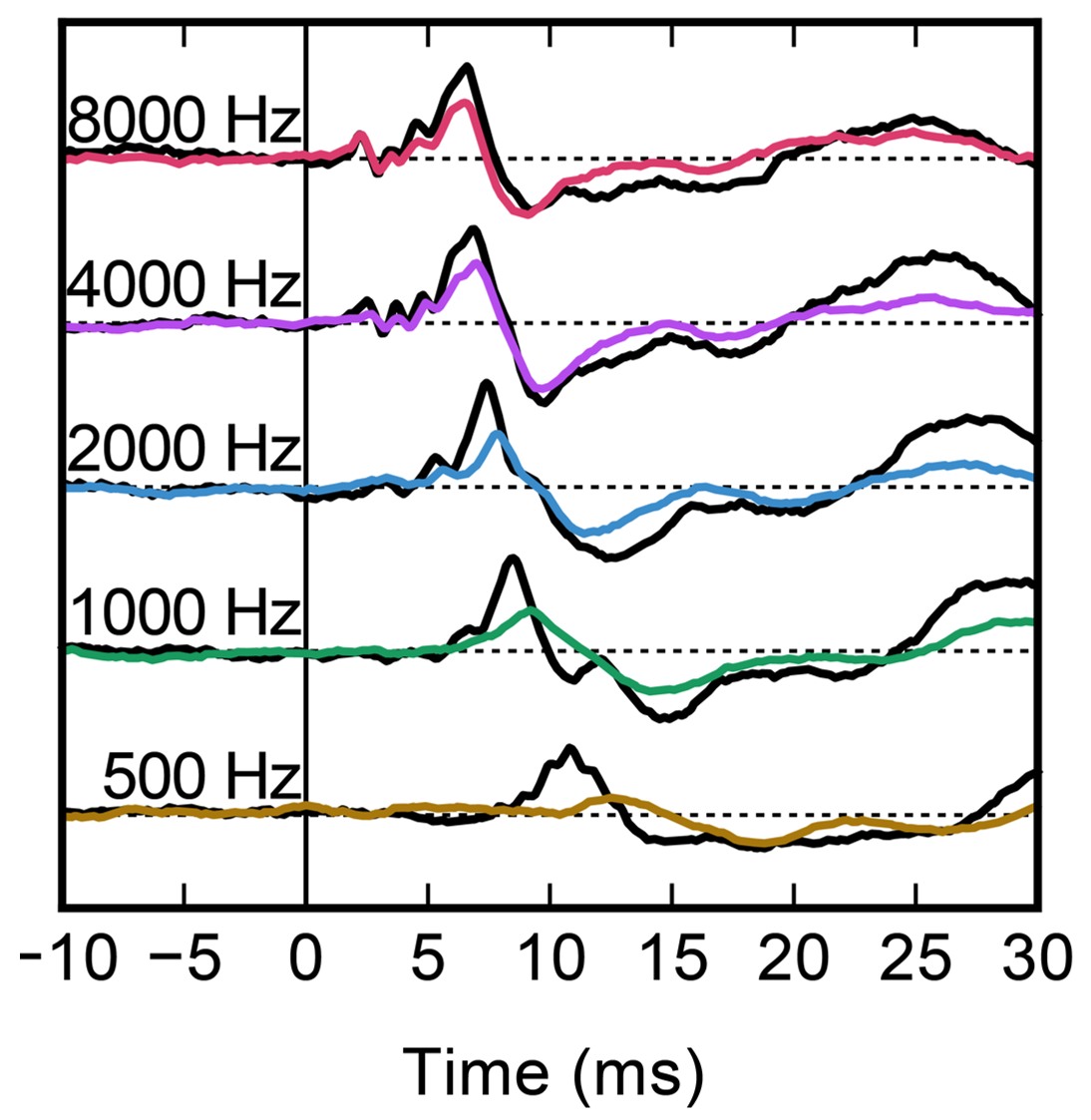
An infant being tested for hearing loss has only as long as their nap. The diagnostic auditory brainstem response (ABR)—the standard test of an infant's hearing—is traditionally measured one frequency, one ear, and one stimulus level at a time, an exam that often runs longer than the patient will sleep. Together with the PoloLab at the University of Minnesota, we are developing the parallel ABR (pABR), which measures responses to every frequency in both ears at once and collapses the threshold search from three dimensions to one. The result is the same waveforms an audiologist already knows how to read, collected in a fraction of the time: in adults with widely varying hearing loss, pABR thresholds correlate with the behavioral audiogram at r = 0.90 and are 2.5 times faster to obtain than with a standard clinical system. Even when a session ends early, the pABR provides at least some information about every frequency in both ears, where serial testing would leave most untested. Our next step is to validate the pABR in infants with hearing loss—the patients who stand to benefit most from a faster, more complete diagnostic test.
Related publications
- Polonenko MJ, Maddox RK (2025). The parallel auditory brainstem response paradigm provides accurate and fast hearing thresholds in a clinic-like setting. medRxiv. Preprint.
- Stoll TJ, Maddox RK (2024). Enhanced Place Specificity of the Parallel Auditory Brainstem Response: An Electrophysiological Study. J Assoc Res Otolaryngol, 25(5), 477-489.
- Stoll TJ, Maddox RK (2023). Enhanced Place Specificity of the Parallel Auditory Brainstem Response: A Modeling Study. Trends Hear, 27, 23312165231205719.
- Polonenko MJ, Maddox RK (2022). Optimizing Parameters for Using the Parallel Auditory Brainstem Response to Quickly Estimate Hearing Thresholds. Ear Hear, 43(2), 646-658.
- Polonenko MJ, Maddox RK (2019). The Parallel Auditory Brainstem Response. Trends Hear, 23, 2331216519871395.
How the brain encodes natural sounds
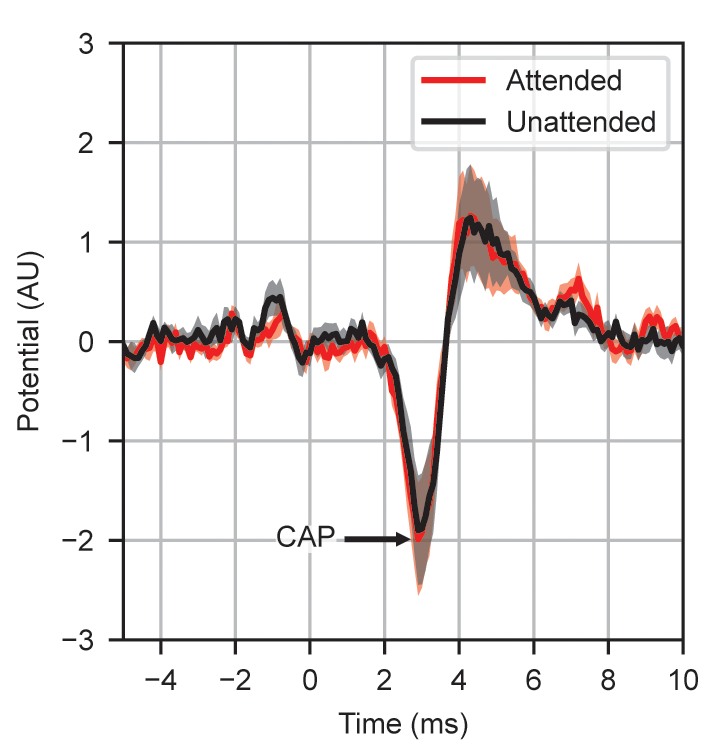
Listening in the real world means picking up a single voice in a crowded room, following a melody over a distant hum, or catching a friend's name on a noisy sidewalk. Most of what we know about how the brain processes sound, however, comes from laboratory experiments that have necessarily reduced these scenes to clicks, beeps, and isolated syllables—the price of the experimental control that traditional methods require. We have developed new ways to measure the human auditory brainstem response (ABR) directly from continuous, naturalistic sounds like speech and music, using carefully designed stimuli ('peaky speech') and signal-processing approaches that account for how the auditory periphery actually responds to complex sound. With these tools we have shown that the brainstem tracks individual talkers in a mixture, that responses to music and speech share more than they differ, and that masking by competing voices shrinks and slows subcortical responses in measurable ways. Our current focus is developing a deep neural network model of human auditory encoding. To do this we will use nearly all the data we have collected in the past decade, while also collecting tens of hours of EEG from each of a small group of listeners—data unlike anything currently available. We will use the model to inform the next generation of hearing aid signal processing and audiologic diagnosis.
Related publications
- Shan T, Lalor EC, Maddox RK (2026). Chimeric Music Reveals an Interaction of Pitch and Time in Electrophysiological Signatures of Music Encoding. J Neurosci, 46(4).
- Figarola V, Li Y, Tierney A, Dick F, Noyce A, Maddox RK, Shinn-Cunningham B (2026). Attention to Pseudotone Melodies Enhances Cortical But Not Brainstem Responses in Humans. J Neurosci, 46(18).
- Stoll TJ, Vandjelovic ND, Polonenko MJ, Li NRS, Lee AKC, Maddox RK (2025). The auditory brainstem response to natural speech is not affected by selective attention. PLoS Biol, 23(10), e3003407.
- Polonenko MJ, Maddox RK (2025). The Effect of Speech Masking on the Human Subcortical Response to Continuous Speech. eNeuro, 12(4).
- Shan T, Maddox RK (2025). Comparing methods for deriving the auditory brainstem response to continuous speech in human listeners. Imaging Neurosci (Camb), 3.
- Polonenko MJ, Maddox RK (2024). Fundamental frequency predominantly drives talker differences in auditory brainstem responses to continuous speech. JASA Express Lett, 4(11).
- Shan T, Cappelloni MS, Maddox RK (2024). Subcortical responses to music and speech are alike while cortical responses diverge. Sci Rep, 14(1), 789.
- Polonenko MJ, Maddox RK (2021). Exposing distinct subcortical components of the auditory brainstem response evoked by continuous naturalistic speech. Elife, 10.
- Maddox RK, Lee AKC (2018). Auditory Brainstem Responses to Continuous Natural Speech in Human Listeners. eNeuro, 5(1).
How the visual system shapes hearing
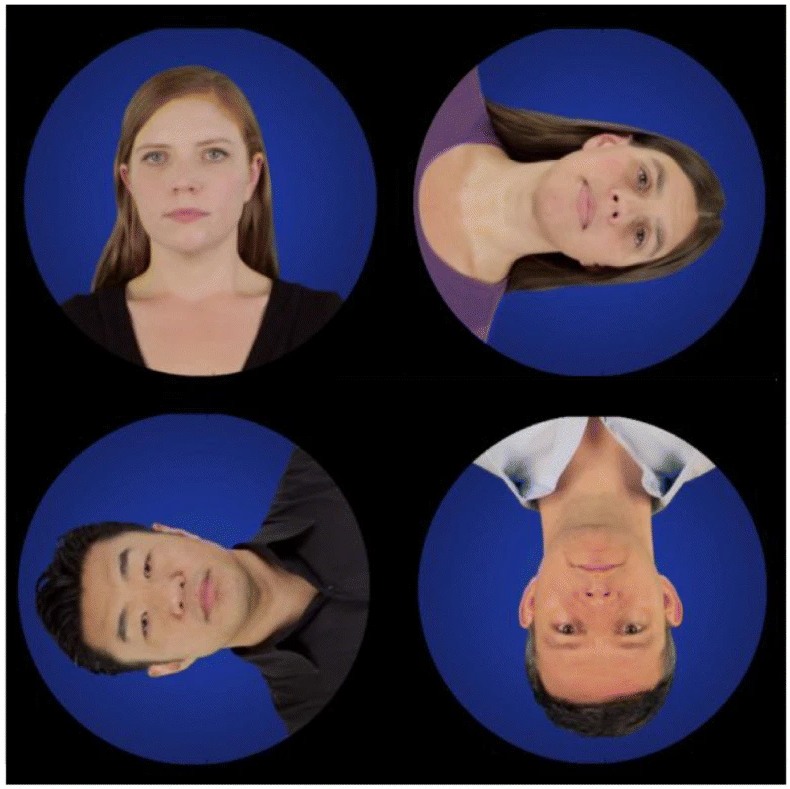
Watching a talker's face helps you understand them in a noisy room. The reason for this is partly obvious—lip-reading conveys phonetic information that the auditory signal alone may not—but the visual system also acts on hearing in subtler ways, biasing what the brain attends to even when the visual cues themselves carry no specific message. We spent several years investigating how vision shapes auditory selective attention, finding that a simple visual signal whose timing matches a target voice can make that voice easier to hear in a mixture, and that this effect operates even when the visual stimulus contains no useful information of its own. In collaboration with Jennifer Bizley's lab at University College London, we showed that the same principle holds in the auditory cortex of the awake animal: visual cues coherent with one of two simultaneous sounds bind to it neurally, helping the brain segregate competing auditory streams. Together these studies established temporal coherence as a genuine mechanism by which vision contributes to listening, complementing the more familiar role of lip-reading.
Related publications
- Cappelloni MS, Mateo VS, Maddox RK (2023). Performance in an Audiovisual Selective Attention Task Using Speech-Like Stimuli Depends on the Talker Identities, But Not Temporal Coherence. Trends Hear, 27, 23312165231207235.
- Fiscella S, Cappelloni MS, Maddox RK (2022). Independent mechanisms of temporal and linguistic cue correspondence benefiting audiovisual speech processing. Atten Percept Psychophys, 84(6), 2016-2026.
- Shan T, Wenner CE, Xu C, Duan Z, Maddox RK (2022). Speech-In-Noise Comprehension is Improved When Viewing a Deep-Neural-Network-Generated Talking Face. Trends Hear, 26, 23312165221136934.
- Fleming JT, Maddox RK, Shinn-Cunningham BG (2021). Spatial alignment between faces and voices improves selective attention to audio-visual speech. J Acoust Soc Am, 150(4), 3085.
- Cappelloni MS, Shivkumar S, Haefner RM, Maddox RK (2019). Task-uninformative visual stimuli improve auditory spatial discrimination in humans but not the ideal observer. PLoS One, 14(9), e0215417.
- Atilgan H, Town SM, Wood KC, Jones GP, Maddox RK, Lee AKC, Bizley JK (2018). Integration of Visual Information in Auditory Cortex Promotes Auditory Scene Analysis through Multisensory Binding. Neuron, 97(3), 640-655.e4.
- Bizley JK, Maddox RK, Lee AKC (2016). Defining Auditory-Visual Objects: Behavioral Tests and Physiological Mechanisms. Trends Neurosci, 39(2), 74-85.
- Maddox RK, Atilgan H, Bizley JK, Lee AK (2015). Auditory selective attention is enhanced by a task-irrelevant temporally coherent visual stimulus in human listeners. Elife, 4.
- Maddox RK, Pospisil DA, Stecker GC, Lee AK (2014). Directing eye gaze enhances auditory spatial cue discrimination. Curr Biol, 24(7), 748-52.